10 Reasons to Include BIM in Your Strategy
Discover how BIM improves visualization, coordination, and efficiency in construction projects.

10 Reasons to Include BIM in Your Strategy
Building Information Modeling (BIM) is no longer an emerging concept. It is a core capability for organizations aiming to remain competitive in the AEC industry. The shift toward digital processes has redefined how projects are designed, coordinated, and delivered.
As companies adopt more advanced technologies and collaborative workflows, BIM stands out as a strategic enabler. It improves decision-making, reduces risk, and increases operational efficiency across the entire project lifecycle.
1. Advanced 3D Visualization
BIM replaces traditional 2D drawings with intelligent 3D models that provide a clearer understanding of projects. This enables teams to isolate elements, filter systems, and analyze components in detail.
For example, it becomes possible to visualize internal systems—such as piping within walls—without ambiguity. This level of clarity reduces misinterpretation and supports better coordination among stakeholders.
2. Virtual Construction Simulation
BIM allows teams to simulate construction before execution. This capability helps identify conflicts, risks, and inefficiencies early in the planning phase.
By anticipating issues, teams can resolve them proactively, reducing costly changes during construction when flexibility is limited.
3. Automated Quantity Take-Off
BIM models function as structured databases, enabling automatic extraction of quantities for materials and services.
This reduces manual effort, improves accuracy, and ensures that data is consistently aligned with project updates and planning phases.
4. Multiple Project Views
BIM enables the creation of customized views tailored to different stakeholders and use cases.
Architects and engineers can present specific sections of a project with relevant technical details, improving communication and making presentations more efficient and intuitive.
5. Automatic Clash Detection
One of BIM’s most critical capabilities is automated clash detection, which identifies conflicts between systems within the model.
This reduces coordination errors and minimizes rework, improving overall project reliability.
6. Parametric and Intelligent Objects
BIM objects are parametric and data-rich, meaning they adapt dynamically to design changes.
For example, if a wall thickness changes, related elements such as doors automatically adjust. This ensures consistency across the model and reduces manual updates.
7. Simplification of Complex Processes
BIM supports the management of complex construction scenarios, including logistics, sequencing, and multi-team coordination.
It enables better control over timelines and execution strategies, especially in large-scale or technically demanding projects.
8. Improved Feasibility for Industrialized Construction
In prefabrication and industrialized construction, BIM ensures geometric and technical consistency before assembly.
This reduces unexpected issues on-site, helping investors avoid delays and unplanned costs.
9. Cost Reduction and Resource Optimization
BIM contributes to cost control by optimizing resource allocation and improving planning accuracy.
By aligning tasks and data across teams, it reduces waste, avoids duplication, and increases productivity.
10. Future-Proofing Your Business
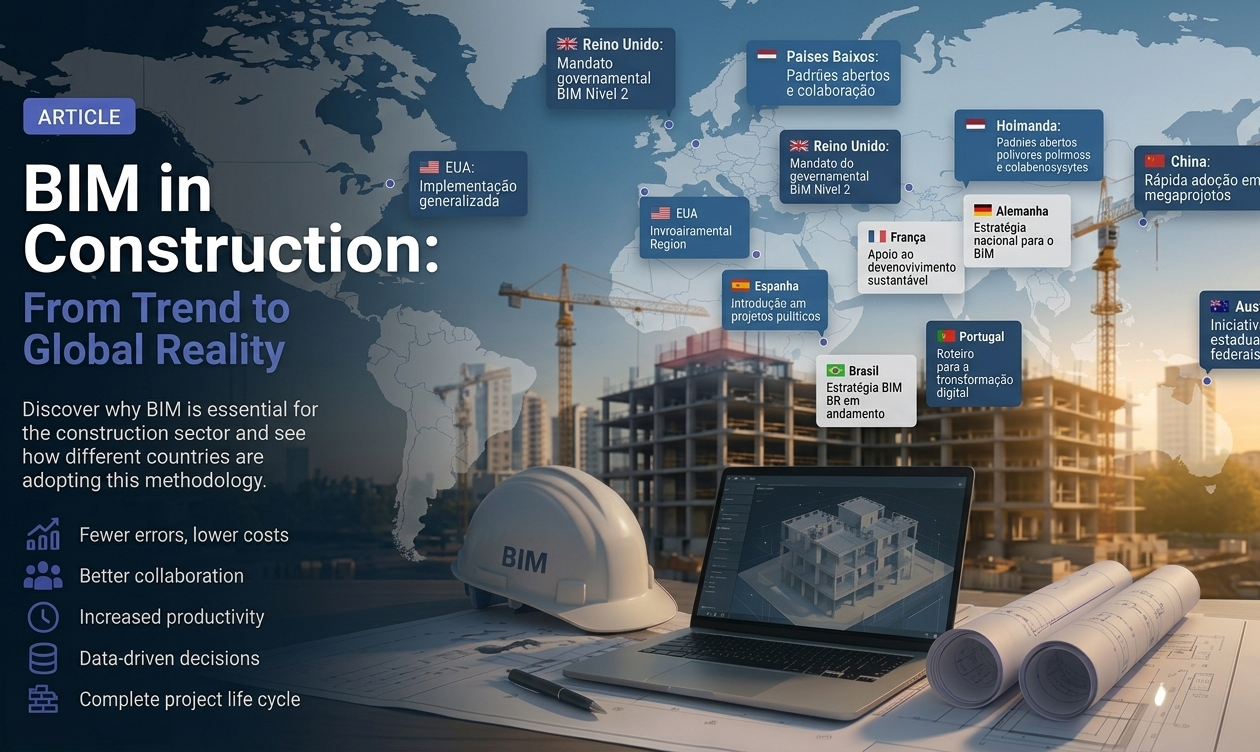
The adoption of BIM is accelerating globally, with many countries already requiring it in public and private projects.
Digital transformation in construction is no longer optional. Organizations that integrate BIM into their strategy position themselves for long-term competitiveness and compliance.
Conclusion
BIM is a strategic asset that enhances visualization, coordination, and decision-making across the project lifecycle. Its adoption leads to measurable improvements in efficiency, cost control, and risk management.
As industry standards evolve, integrating BIM into your business strategy is essential to remain relevant and competitive in the AEC sector.
Ready to see BIMWorkplace in action?
Centralize your project, your team, and your data in one platform built for AEC.
Get BIM insights in your inbox
Practical articles, product updates, and AEC best practices. No spam.