Clash Detection in BIM: Why BIM Managers Should Care
Clash detection in BIM reduces errors, improves coordination, and prevents costly rework in construction projects.
Clash Detection in BIM: Why BIM Managers Should Care
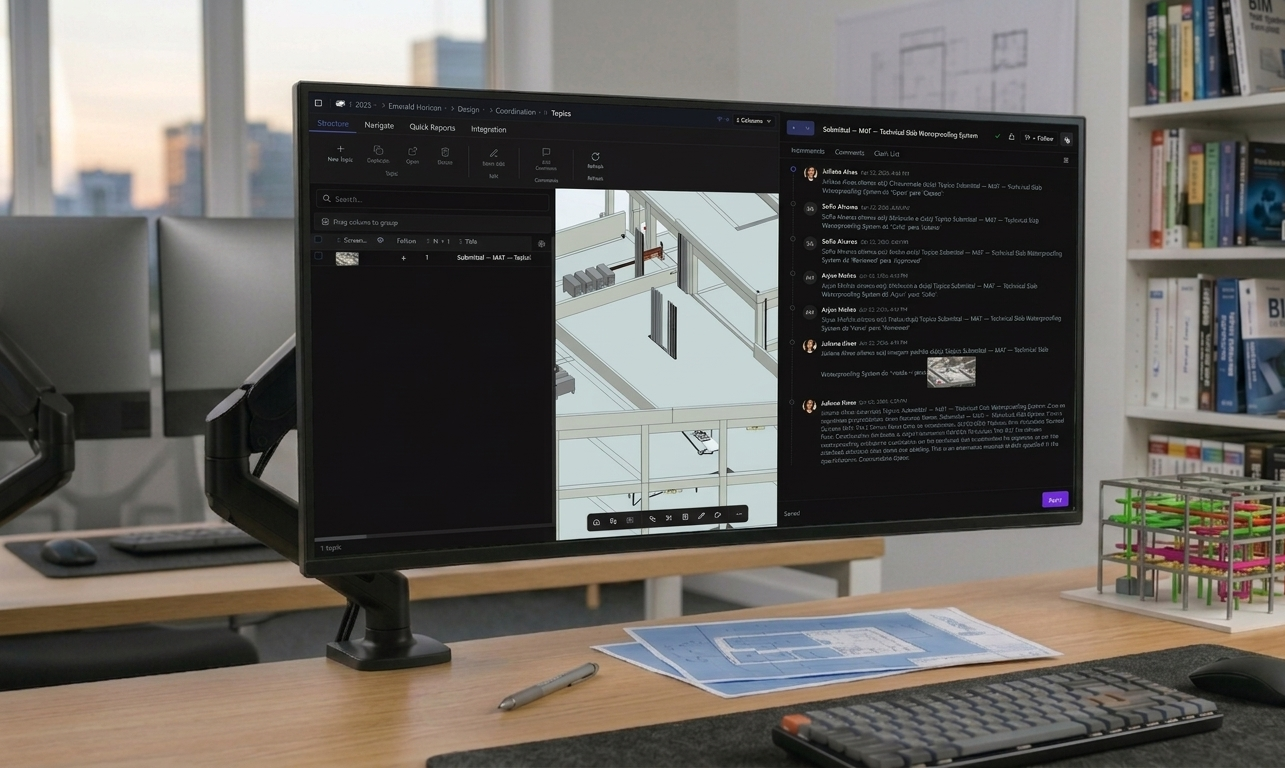
Discovering a clash during construction, such as an HVAC duct intersecting a structural beam, creates immediate disruption. These situations lead to delays, change orders, and increased costs.
For BIM Managers, these issues are not unexpected, they are preventable through structured coordination. This is where clash detection in BIM becomes a critical process, supporting more predictable, efficient, and controlled project delivery.
What Is a Clash in BIM?
In Building Information Modeling (BIM), a clash occurs when elements from different disciplines conflict either physically or logically within the model.
If unresolved, these conflicts translate into costly corrections during construction.
Types of Clashes in BIM
Hard Clashes: Physical intersections between elements (e.g., a pipe crossing a beam)
Soft Clashes: Violations of required clearances or buffer zones
Workflow (4D) Clashes: Conflicts related to sequencing and construction timing
What Is Clash Detection in BIM?
Clash detection is the automated process of identifying these conflicts within a federated model before construction begins.
It enables multidisciplinary teams to coordinate designs in a shared digital environment, ensuring issues are detected and resolved early in the project lifecycle.
Why Clash Detection Matters in Construction
Clash detection delivers measurable impact across cost, time, and quality.
Reduce Errors
Early issue identification prevents rework and minimizes disruptions on-site.
Improve Planning
Supports constructability analysis and validates sequencing through 4D simulations.
Control Costs
Resolving clashes during design significantly reduces construction-phase expenses.
Increase Productivity
Eliminates delays caused by on-site problem solving and improves execution flow.
Enable Prefabrication
Coordinated models allow accurate off-site fabrication of components.
Strengthen Collaboration
Centralized model coordination aligns architects, engineers, and contractors.
Common Challenges in Clash Detection
Despite its value, many teams struggle to implement clash detection effectively.
Inconsistent interoperability between modeling tools
Large volumes of clashes with no clear prioritization
Fragmented assignment and tracking of issues
Manual workflows using spreadsheets
Communication gaps delaying resolution
The Clash Detection Workflow
A structured workflow is essential to ensure consistency and efficiency.
1. Model Creation
Each discipline develops its own model (architecture, structure, MEP).
2. Model Federation
Models are combined into a single federated environment.
3. Ruleset Definition
Define tolerances, clearances, and critical zones based on project requirements.
4. Clash Analysis
Detection tools identify conflicts automatically across disciplines.
5. Conflict Identification
Clashes are filtered by type, severity, and location.
6. Coordination and Resolution
Issues are assigned, discussed, and resolved through coordinated workflows.
7. Documentation and Closure
Resolved clashes are tracked and closed, ensuring the model remains coordinated.
How BIM Enables Effective Clash Detection
BIM provides the foundation for scalable and reliable coordination.
Model Federation: Integration of multidisciplinary data into one environment
Real-Time Updates: Access to current and consistent information
Data-Driven Decisions: Use of structured model data for analysis
Performance Monitoring: Dashboards and metrics to track coordination
Cloud Collaboration: Remote access and continuous team alignment
Conclusion
Clash detection in BIM is a risk mitigation process that directly impacts project performance. It transforms coordination from reactive problem-solving into proactive planning.
For BIM Managers, mastering this process is essential to reduce rework, control costs, and ensure reliable project delivery. In a high-risk environment like construction, structured coordination is not optional—it is fundamental.
Ready to see BIMWorkplace in action?
Centralize your project, your team, and your data in one platform built for AEC.
Get BIM insights in your inbox
Practical articles, product updates, and AEC best practices. No spam.