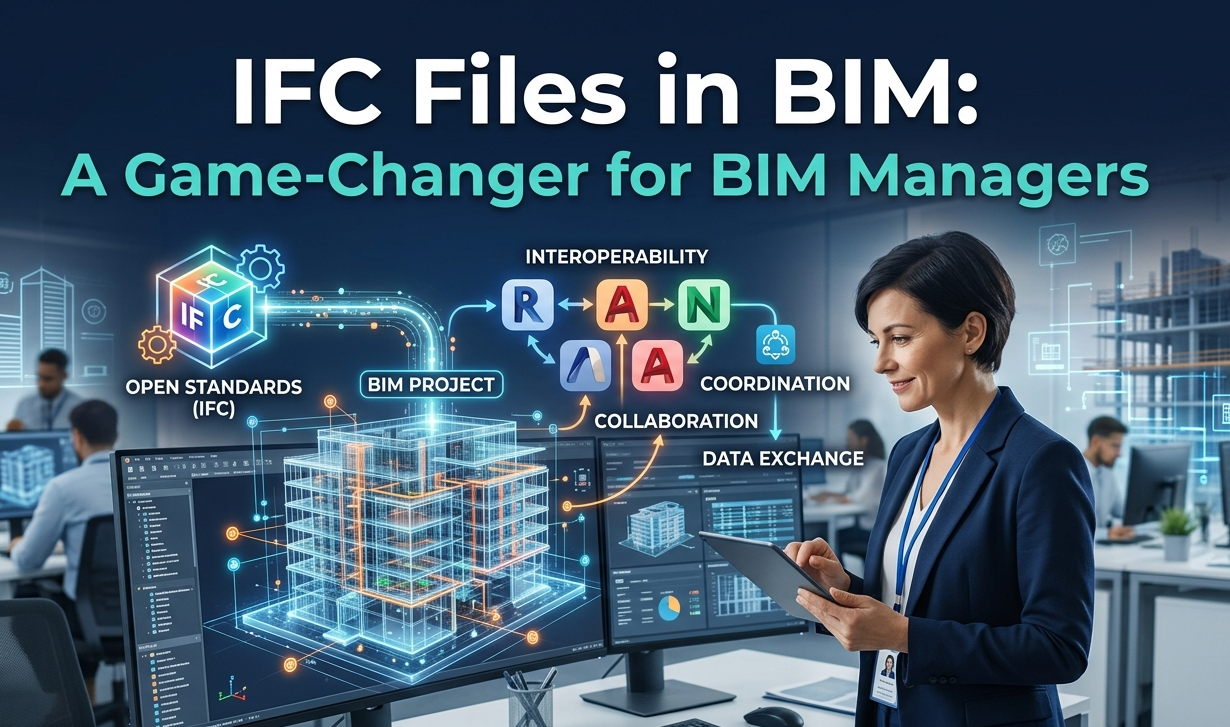
IFC Files in BIM: A Game-Changer for BIM Managers
Understand how IFC enables interoperability, improves collaboration, and enhances data management across BIM workflows.
IFC Files in BIM: A Game-Changer for BIM Managers
As Building Information Modeling (BIM) becomes a cornerstone of modern construction, understanding the role of IFC (Industry Foundation Classes) is essential, especially for BIM Managers responsible for coordinating multidisciplinary teams and ensuring data consistency throughout the project lifecycle.
In increasingly complex AEC environments, where multiple stakeholders rely on different software tools, IFC plays a critical role in enabling seamless collaboration, reducing data loss, and improving decision-making.
What Is IFC and Why Was It Created?
IFC (Industry Foundation Classes) is an open, neutral data format developed by buildingSMART to enable interoperability between different BIM software platforms.
In practice, IFC acts as a universal language that allows design tools, modeling platforms, and project management systems to exchange information without compatibility issues.
The primary reason for its creation was to solve a fundamental challenge in the AEC industry: fragmented workflows and data silos.
IFC addresses this by standardizing how information is structured and shared across platforms.
How IFC Works: Understanding Its Structure
An IFC file organizes building data in a structured and logical way, mirroring real-world construction elements and relationships.
Entities: Represent physical elements such as walls, doors, and HVAC systems.
Attributes: Define properties like dimensions, materials, and manufacturer data.
Relationships: Establish how elements connect.
Inheritance: Enables reuse of properties across similar elements.
Property Sets (Psets): Allow customization of project-specific data.
This ensures IFC models are not just geometry, but data-rich assets with context.
IFC and BIM: A Symbiotic Relationship
Enhanced Interoperability
IFC is platform-neutral, enabling seamless exchange between tools like Revit, Archicad, Tekla, and Navisworks.
Data Integrity
Standardization ensures consistent and reliable data transfer, reducing errors and rework.
Improved Collaboration
Teams work from a shared source of truth, improving coordination across disciplines.
Efficiency and Cost Optimization
Fewer design conflicts
Reduced rework
Better cost control
Lifecycle Data Management
IFC supports the entire asset lifecycle, enabling long-term data continuity.
Key Benefits of IFC Files for BIM Managers
If you're a BIM Manager, these are the practical advantages of using IFC in your workflows:
Tool Independence: Collaborate with any stakeholder, regardless of the software they use.
Data Control: Easily manage and validate project information for compliance and quality assurance.
Reuse & Scalability: Apply templates and structures across projects, scaling coordination efficiently.
Transparency: Clear data structures enable easier auditing, tracking, and accountability.
Risk Mitigation: Reduce errors caused by file conversions and metadata loss.
IFC Files as a Strategic Asset for BIM Managers
For BIM Managers, success depends on delivering projects that are data-driven, coordinated, and error-free.
IFC is not just a technical format, it is a strategic enabler of reliable interoperability and streamlined collaboration.
When combined with platforms like BIMWorkplace, its impact is amplified through centralized data, real-time collaboration, and improved project visibility, addressing common industry challenges such as fragmented workflows and lack of data consistency.
Conclusion
IFC is the foundation of openBIM, enabling true collaboration across tools, teams, and project phases.
For BIM Managers, mastering IFC is essential to ensure data integrity, efficiency, and better project outcomes.
Organizations that leverage IFC effectively will be better positioned to deliver projects on time, within budget, and with greater confidence.
Ready to see BIMWorkplace in action?
Centralize your project, your team, and your data in one platform built for AEC.
Get BIM insights in your inbox
Practical articles, product updates, and AEC best practices. No spam.