Software Dialogue: From Technical Interoperability to Strategic Success in BIM
Interoperability in BIM is not just a technical requirement—it is a strategic driver of productivity, cost efficiency and long-term asset value. Discover how open standards like IFC and structured workflows transform fragmented data into seamless collaboration.
Software Dialogue: From Technical Interoperability to Strategic Success in BIM
In today’s construction landscape, the greatest bottleneck to productivity isn’t individual professional skill, but the connection between them. The digital construction site has become a complex ecosystem, and without fluid dialogue between software, we are merely digitizing chaos.
Imagine an orchestra where each musician follows a different notation system: one reads only by colors, another by letters, and the conductor leads with improvised hand signals. Without a common standard, the result isn’t music; it’s noise, delays, and inevitably, financial loss. In BIM, interoperability is the mastery that unifies these standards into a flawless performance.
1. Why does the “conversation” freeze?
Historically, the AEC (Architecture, Engineering, and Construction) software industry grew in silos. Software giants developed proprietary ecosystems with closed formats such as .rvt, .pln and .dwg. The problem arises when data needs to cross the border between different specialties.
When dialogue between software fails, we face the “Three Horsemen of Waste”:
Loss of Semantic Information
A “smart” wall, containing thermal transmittance and cost data, turns into a generic geometric object when opened in another software. The geometry remains, but the intelligence is lost.
Analog Rework
Professionals are forced to redraw elements that have already been modeled because downstream tools cannot interpret upstream data.
Metadata Corruption
Critical schedule information or material specifications are lost or altered during export and import processes.
2. IFC: The Hope for Digital Construction
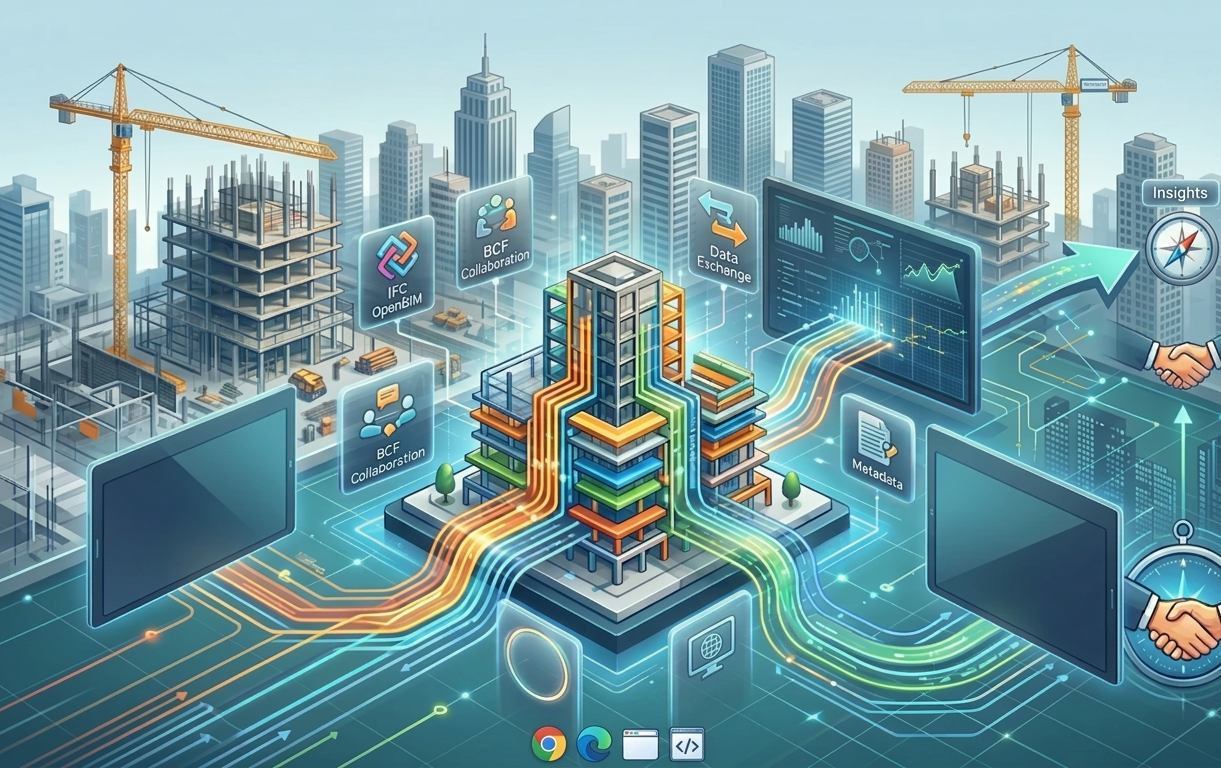
For dialogue to flow in a multidisciplinary environment, a common language is required. This is where IFC takes center stage.
Developed by buildingSMART, IFC is not just a file format; it is a neutral and open data schema designed to enable interoperability.
Adopting OpenBIM, the philosophy of working with open formats, is a strategic decision that guarantees:
Vendor Independence
Organizations avoid being locked into a single software ecosystem and gain flexibility to choose the best tools for each task.
Data Longevity
An IFC file can be accessed decades later, even if the original authoring software no longer exists. This is critical for long-term asset management.
3. Beyond the “Export” Button
Interoperability is not achieved by simply clicking “Export.” High-performance data exchange requires structured configuration based on three technical pillars.
Class and Parameter Mapping
The originating software must correctly map its internal objects to IFC classes. A beam must be exported as IfcBeam, not as a generic object. Additionally, parameters such as material strength must be structured into Property Sets (Psets) so that receiving software can interpret them correctly.
The Role of BCF (BIM Collaboration Format)
If IFC is the language, BCF is the communication channel. It allows teams to exchange issues using screenshots, viewpoints and comments without resending heavy models. This enables real-time coordination between disciplines.
Interoperability Matrix
A common mistake is attempting to share all data with all stakeholders. Efficient workflows define who needs what information. A structural engineer needs loads and opening dimensions, not door handle finishes. Filtering data reduces errors and improves performance.
4. The Manager’s Role in Conducting this Dialogue
Technology alone cannot solve interoperability challenges; governance is essential.
At BIMWORKPLACE, management is treated as the element that binds systems and workflows:
BEP (BIM Execution Plan)
The central document defining software versions, exchange formats and update frequencies. Without it, each stakeholder operates with different assumptions.
CDE (Common Data Environment)
A centralized platform that acts as the single source of truth for all project data.
Auditing and Quality Assurance (QA)
Continuous validation is required. Exporting, reimporting and verifying models ensures that information integrity is maintained across systems.
5. Why is this profitable?
Interoperability is not a technical luxury; it is a financial driver.
Reduced Deadlines
Projects with efficient software communication can reach construction phases up to 20% faster due to fewer coordination cycles.
Budget Accuracy
Reliable data exchange between BIM models and ERP systems significantly reduces the risk of material underestimation.
Operation and Maintenance (6D/7D)
The long-term value of BIM lies in operations. A well-integrated model allows owners to access accurate information about assets, reducing lifecycle costs.
6. How to Start Implementing Fluid Dialogue
Organizations facing issues such as incompatible files or broken models should focus on three key actions:
Workflow Diagnosis
Identify where information flow breaks and which tools are causing friction.
Template Standardization
Ensure consistent coordinate systems, classifications and naming conventions across all platforms.
Strategic Training
Train teams to prepare models for downstream use, not just to produce geometry.
Conclusion
Dialogue between software is ultimately a reflection of organizational culture. Systems that do not communicate often mirror teams that do not collaborate.
By removing interoperability barriers, companies unlock both technical efficiency and creative potential.
At BIMWORKPLACE, the focus is on transforming fragmented communication into a continuous and reliable data flow, eliminating the “game of telephone” that compromises project outcomes.
Does your organization still operate in a closed ecosystem, or are you already experiencing the benefits and challenges of OpenBIM?
Ready to see BIMWorkplace in action?
Centralize your project, your team, and your data in one platform built for AEC.
Get BIM insights in your inbox
Practical articles, product updates, and AEC best practices. No spam.